Deuex · Highflame · Jun 2025 – Jul 2026
Code Agent Security & Observability
Enterprise LLM Security Platform · Code Agents
Highflame is a security and observability platform for AI coding agents — Cursor, Claude Code, and others — used by engineering teams to see what their agents are doing and stop the dangerous parts. As senior engineer on the Code Agents module, I built its UI from scratch: the navigation, agent discovery, usage dashboards, threat and violation review, command analysis, and onboarding, then kept pushing on consistency, reliability, and reach as the platform matured.
Building the Code Agents UI from scratch
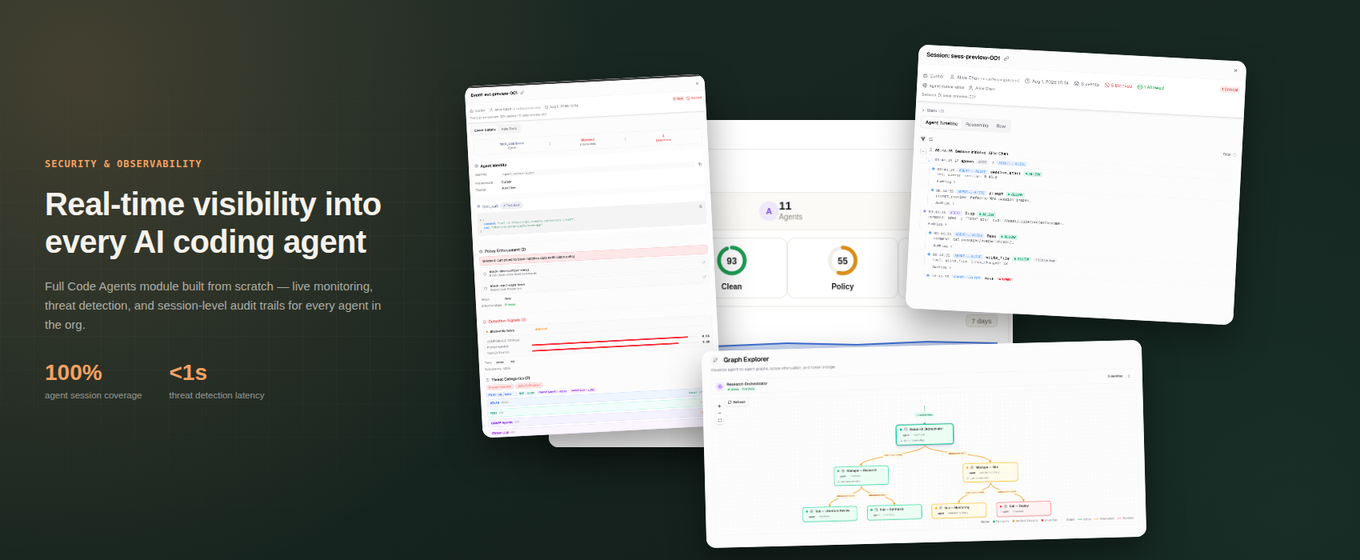
There was no existing surface for this — I built the Code Agents module end to end: navigation and agent discovery, usage dashboards, threat and violation review, command-level analysis, and the onboarding flow that gets a new workspace instrumented. It's the module teams open first to see what their Cursor, Claude Code, and other AI agents have been doing.
Reviewing threats down to the exact tool call
Flagging a threat isn't useful unless a reviewer can see exactly why. I built the event detail view that shows the tool call an agent made, which policy it tripped, and the detection signals behind the score — so a security reviewer can confirm a block, or catch a false one, in seconds instead of digging through raw logs.
Catching problems before they were reported
On the legacy platform, PostHog was already integrated. During a routine check of the data, I noticed users were struggling to get through signup. The terms-and-conditions checkbox was easy to miss, leaving the submit button disabled with no visible reason.
Integrating PostHog into the new Studio platform surfaced a different kind of problem: browser ad blockers can silently prevent events from being recorded, which undermines the reliability of the analytics itself. I traced the cause and identified a Next.js proxy approach as a way to route around it.
One definition of "threat," adopted everywhere
There was no consistent definition of what counted as a threat across the platform. I drove alignment with engineering and product on a single, platform-wide definition instead of leaving it to vary by surface.
- Policies triggered = threats
- Rules broken = threats
- Any insecure event = threats
- Led a full data-layer migration across Code Agents pages as legacy APIs were deprecated — rewriting hooks and validating correctness to keep the product live throughout.
- Contributed backend fixes across repos — API endpoints, data aggregation — to unblock delivery rather than wait on backend availability.
- Self-initiated UI/UX consistency reviews across Studio modules, standardising severity colors, chart styles, policy UX, page titles, and terminology.
- Led a full mobile responsiveness pass across the platform, making it usable on mobile.
- Owned the Provider–Route consolidation — merging two disconnected UIs into a single navigation flow instead of patching them independently — resolving the gateway's main usability issue.
- Fixed critical UX and auth-flow issues — developer redirects, broken admin invites, default policy misconfigurations, and stale side-panel data — on a security product where correctness directly affects trust.
- Maintained the Playwright E2E suite across pages, stabilising CI and keeping deployments safe.